 Includes members-only content
This summer, I refined an illustration of a high school girl enjoying nagashi somen through conversation with AI. Here is how it came together.
It is already late September. We are slowly moving from chilled somen to warming bowls of udon, but today I want to look back at a summer illustration project.
It was the end of July. The heat was relentless, and I wanted an illustration of a beautiful girl that would make me feel cooler just by looking at it.
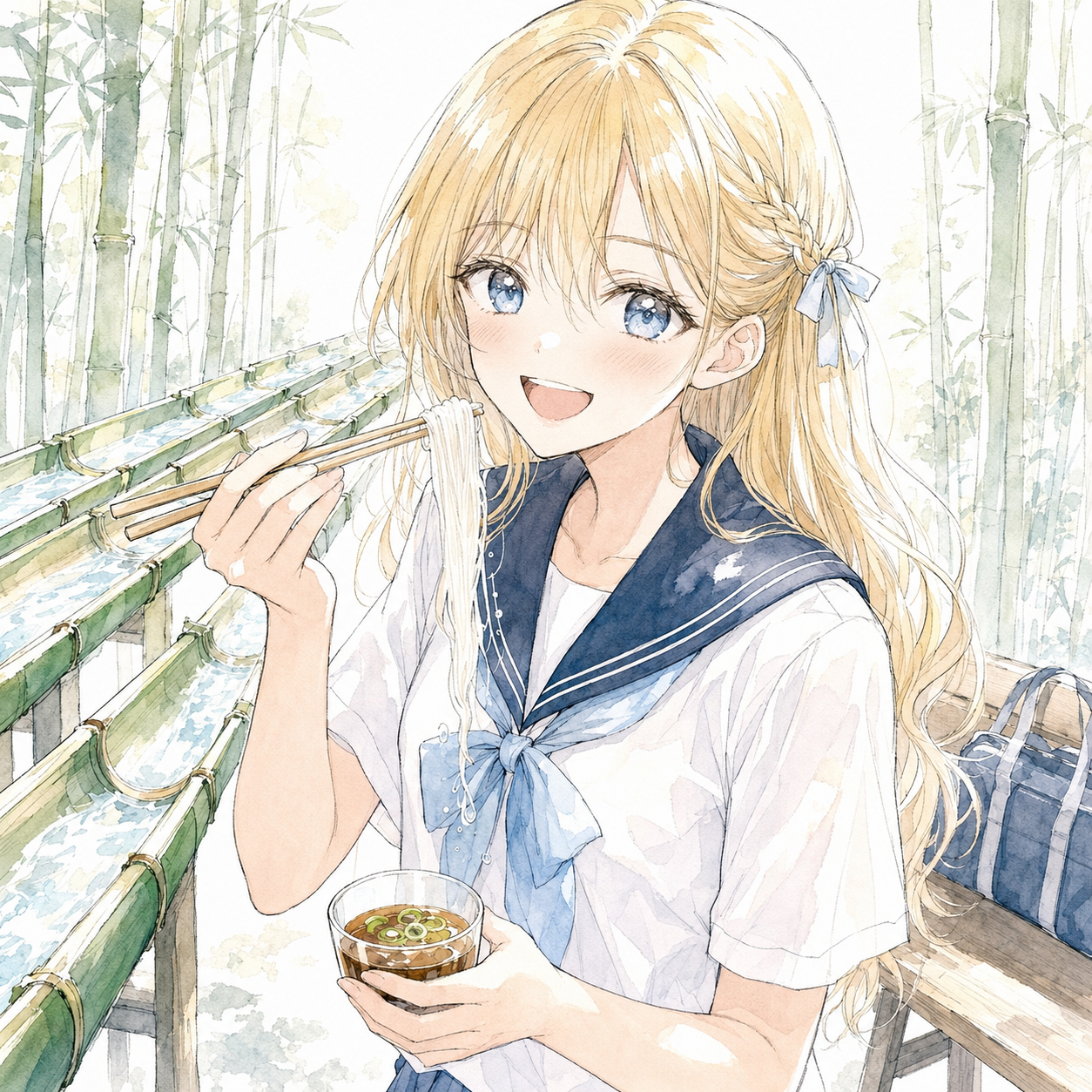
The theme I chose was nagashi somen: thin white noodles sent flowing down a bamboo flume in cold water, caught with chopsticks as they pass. The scene is a small restaurant beside a bamboo grove, and a high school girl enjoying the noodles as they come.
The main character is the blonde, blue-eyed girl I have been drawing for some time. She is a perfectly polite honor student—or at least, that is her backstory for now. But put her in front of a stream of somen, and her composure slips. That was the moment I wanted to capture, and I worked toward it through conversation with AI.
As usual, her expression came together quickly. What kept giving me trouble was the bamboo flume carrying the noodles. This is the story of my little battle with that bamboo.
An Honor Student Gets Serious About Noodles
All I told the AI at first was a single line: "a high school girl enjoying nagashi somen."
In our conversation, we settled on separating the scene into moments instead of packing everything into one image: taking aim at the approaching noodles, catching them with chopsticks, and proudly showing off the catch. Three moments.
The appeal was the contrast in her expression. The normally composed honor student lets out a cheer the instant she catches the noodles. While taking aim, she looks as serious as she would tackling the last question of a mock exam. Her opponent? A bundle of noodles drifting toward her.
I liked this setup, and prepared four versions. A wide shot, a close-up, the dead-serious face, and a bonus scene set in her grandparents' garden.
I generated the images with ChatGPT’s image-generation feature, recorded at the time as GPT Image 2. I reviewed each result, described what bothered me, and repeated the process of revising the prompt and generating another image.
Beautiful, Except the Bamboo Was Too Big
Every image that came out was beautiful. The expressions were exactly what I had aimed for. The sparkle on the water looked cool and fresh.
But the bamboo was too big.
The bamboo flume carrying the noodles was drawn much thicker than I intended. It looked less like nagashi somen and more like a small irrigation channel. In three of the four versions, something about the bamboo’s shape or scale felt wrong.


The bamboo was not the only problem. The school bag that was supposed to hang from her shoulder had turned into a large sports bag for club activities. In the garden version, the small figures in the background were crushed into something like a mosaic.
Going back over the prompt with the AI, I noticed an omission. I had described the shape: bamboo split in half, joined end to end, and held up on legs. But I had not said anything about its size.
How thick is the bamboo in nagashi somen? To me it was too obvious. So obvious that writing it down never occurred to me.
So I added approximate dimensions for the image I wanted: bamboo about ten centimeters in diameter, a channel roughly the width of her palm, and a flume at waist height. I used comparisons with her body as well as numbers, and added the bamboo’s natural nodes to the description.
With those changes, the wide shot came out almost exactly as I wanted. They did not fix every version at once, but they showed me the value of spelling out a size I had taken for granted. That was one of the biggest lessons of this project.
What Exactly Is "AI-Looking Light"?
The close-up still bothered me, too.
The bag and the bamboo’s scale had improved. Yet something still felt off. To my eye, the lighting resembled the AI illustrations I often see.
I told the AI exactly that. Its proposal was a style of line art with pale watercolor washes, with the lighting effects held back. When I tried it, the image did look cleaner. But it was the opposite of the direction I wanted. The more revisions I stacked up, the less convincing it became.
So I stopped relying on words alone and provided one reference illustration with the atmosphere I wanted.
The AI put the features of that picture into words for me. Fine, delicate lines. Translucent coloring. The contrast of warm light against cool shadow.
What I wanted was not to remove the light. I realized that what mattered was to build the light again, with more care.
I translated that idea into the nagashi somen scene: golden sunlight through the leaves against the blue-green shade of the bamboo grove. Here is the result, generated with the reference illustration and then given an additional correction to the bamboo flume.
The flume on the right did not come out right on the first attempt, so I asked for another correction in the same conversation. After that adjustment, the result felt “pretty much right.”
For this style adjustment, showing one image made it easier to share the direction I had in mind than explaining it in words alone. That was another lesson I learned by trying it.
Some versions, on the other hand, never worked out. The dead-serious face: two attempts, and the perspective and the size of the bamboo never agreed. The garden version: after I removed the background figures and tidied it up, she now looked like "a mother sending the noodles down the flume."
What worked, and where did I get stuck? In the rest of the article, I look back at both alongside the prompts I actually used.
Continue reading with membership
Sign in with a membership plan that includes this article.
Sign in / Join free