A manga-inspired illustration, refined through a conversation with AI. I work through a mismatch between title and expression, rethink facial shading, and move the scene from a concert to social media, with practical prompts along the way.
It had been a while since I last made an illustration with AI and shared it, and I felt like trying again.
The theme was cheering someone on. Inspired by a manga, I wanted to capture the feeling of putting your whole heart into supporting someone, with an almost ridiculous amount of energy. No speech bubbles or dialogue: the emotion had to come through in the expressions and gestures. That was where the conversation began.
But when I looked at the generated image, something felt off. It was beautiful, yet it did not quite match the title I had in mind. As I kept talking it through with AI, I ended up revisiting the title, the expression, the facial shading, and even the setting.
This practical note follows that process. I wrote it to give you a taste of the kinds of things you can read about here at Atelier Lab!
The first idea: applause turned up to eleven
The first composition had a person in the foreground clapping with all his might. Behind him, a glowing humanoid figure was clapping just as furiously.
All that extraordinary power, devoted entirely to cheering someone on. I wanted the sheer exaggeration to make the image a little funny.
I was also thinking about how the scene would look to someone else. Even if I intended it as encouragement, the expression or the distance between the characters might make it look as though the supporter was crowding the other person.
So I placed the supporter in the audience and the person he was cheering for onstage. The performer would wave to the audience as a whole, with other people around the supporter enjoying themselves too. The energy would be concentrated in the foreground character, while the overall scene stayed bright and welcoming.
Does a line that sounds familiar actually have a source?
Alongside the illustration, I was discussing possible titles.
The first suggestions included dramatic lines along the lines of “When it comes to cheering you on, I won’t hold baaack!!” What I wanted, though, was a playful variation that would remind people who knew the manga of the original line.
I asked whether the suggestions were actually based on particular lines. The AI explained that the earlier ideas were written to capture the sound and feel of the dialogue, rather than adapted from a specific quote.
I was glad I checked. A phrase can sound convincing without having an actual source.
After checking the source again, this was the version I liked:
ふるえるぞハート! 燃えつきるほどエーーールッ!!
A loose English rendering of this adaptation would be: “My heart is trembling! I’ll cheer until I burn out!!” I checked the wording of the line that inspired it in an official collaboration announcement. In Japanese, the original ends with hīto, “heat.” Replacing that word with ēru, meaning encouragement or cheering someone on, keeps the rhythm while changing the meaning. The references are listed at the end.
The cheering version above was an adaptation developed during our conversation, not an original line from the manga or an official English translation.
The title was fired up. The image looked relaxed.
Here is the generated image I was looking at around that point.
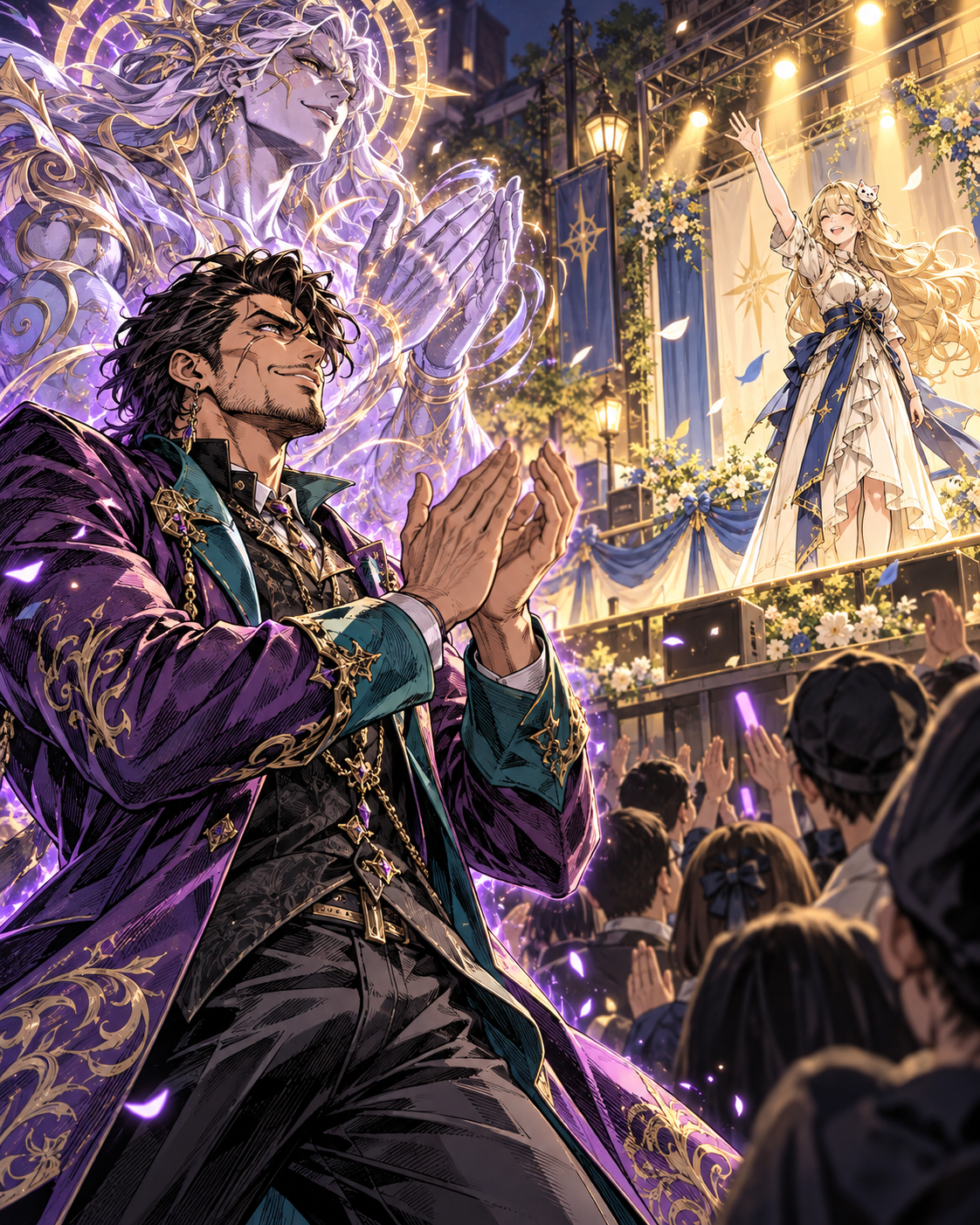
An image from the work in progress. The lively stage and applause are there, but the supporter looks as though he is enjoying himself at a fairly relaxed pace.
The clothes and lighting were striking, and the overall direction was promising. Still, next to a title about cheering until you burn out, the image felt a few degrees too cool.
I asked whether the gap between the title and the illustration might make the intended meaning hard to understand.
Looking back at the original prompt, I found phrases such as “a small, confident smile” and “an elegant spirit figure.” At least some of my own instructions were steering the image toward that calmer impression.
For the next version, I broke the title’s ideas down into visible actions.
What I wanted to express | What I specified in the image |
|---|---|
His heart is pounding | One hand rests on his chest, with ripples of light spreading outward. |
His feelings are overflowing | His hair and clothes move, while light rises around his body. |
He is cheering with all his might | His other hand is cupped beside his mouth as he cheers with a joyful expression. |
For this version, I set aside the large figure behind him and focused the expression and movement on the supporter himself.
The conversation had moved beyond simply asking for more intensity. I was starting to think about which expressions and actions would actually make that intensity visible.
Rethinking the face meant rethinking the shading
The supporter’s face was the next thing that caught my attention.
I had an adult Japanese man in mind, but the features looked more sharply sculpted than I had imagined. Adding “Japanese man” to the prompt still did not give me the impression I wanted.
For this particular character, I described the contours and shading I wanted more precisely.
Keep the nose bridge modest, drawing it with short lines and small shadows.
Avoid overly deep shadows around the eyes and beside the nose.
Soften hollow cheeks and an angular jaw into gentler contours.
Keep the delighted expression as he cheers.
At the same time, I wanted to keep the exaggerated manga energy in the pose, clothing, colors, and lighting effects.
If I ask for strong shading across the whole image, that treatment can carry over to the face as well. Describing the face, clothing, and background separately gives me a clearer way to ask for different treatments. That is one technique from this exchange I want to remember.
From a concert venue to a single Like on social media
As the conversation continued, I realized the scene strongly suggested being at a pop idol’s concert. I also wanted to explore what cheering someone on through social media might look like.
The idea became the moment when someone looks at a post on his phone and taps Like once.
The action is tiny, but in his heart he is cheering with everything he has. I proposed showing that contrast with golden light traveling from his chest to his fingertip.
Changing the setting also changed what needed to be specified. For the social media scene, I made these relationships especially clear:
The male supporter is the only person physically present in the room.
The woman appears only in a photograph within a public post on the phone screen.
The hand holding the phone and the hand tapping Like both connect to the same person’s body.
The heart on the screen is the Like button. There are no hearts floating in the air.
I broke “supporting someone on social media” down into where each person was, the boundary of the phone screen, and the movement of the hands. Once again, I needed to spell out the relationships I wanted the image to show.
Exploring other versions of the same idea
Along the way, I also discussed a version with a more conventional anime look. It would keep the hand over the chest and the delighted expression, using dusk or warm stage lighting in place of supernatural light.
I also returned to the original applause composition and proposed switching the supporter to an adult blonde woman, with a male idol onstage. I clarified the roles: the man would hold a microphone, while the woman and the spirit figure behind her would clap.
This was another variation on the original applause scene.
Even with the same theme of encouragement, changing the visual style, the setting, and the characters’ roles are different choices. Thinking about them separately made it easier to see which directions I wanted to explore.
A revision request I would use again
One thing that helped throughout this exchange was explaining both what I liked and what felt wrong.
If I like the composition and only want to change the face, I should say that I want to keep the composition. If I am moving the scene to social media, I can specify that the face and color palette should carry over from the reference image, while the background and pose should be rebuilt.
I put together the following template for this article, based on that conversation.
Please help me write a revision prompt for this image using the points below.

What I want to convey:
[Example: The moment when the joy of cheering someone on shows spontaneously on his face.]

What I like about the current image:
[Example: The placement of the characters, the clothing colors, and the atmosphere of the background.]

What does not match my idea:
[Example: The calm expression and closed mouth do not convey the energy of cheering.]

What I want to change this time:
[Example: An open-mouthed, delighted expression as he cheers, with one hand cupped beside his mouth.]

What I want to keep:
[Example: The character’s apparent age, the clothing color palette, and the distance from the stage.]

Use the reference image for the elements I want to keep.
If any requested changes conflict with what I want to preserve, point that out first.
OpenAI’s image prompting guide also recommends specifying visible arrangements and actions, and making clear what should change and what should stay the same when editing. After writing the instructions, I still need to check the generated image to see whether the parts I wanted to preserve have changed. The guide is linked in the references.
I could not describe the finished image perfectly from the start. Looking at each result, noticing that something felt off, and putting that feeling into words gradually helped me understand what I wanted.
Appendix: the full prompt for the social media scene
The following is a proposed prompt, adapted for this article from the social media version developed during the conversation. References to a particular work have been replaced with concrete descriptions of poses, shading, and colors. It is intended to generate a new composition without a reference image. A prompt is simply a set of instructions for the AI.
I have not verified the generated result of this particular version for this article. If you try it, check the expression, the direction of the phone screen, how both hands connect to the body, and the positions of the people inside and outside the screen.
Create a vivid, theatrical manga illustration of a Japanese adult man sending encouragement through social media.

Portrait format, approximately 4:5. One continuous scene, without comic panels or written dialogue.

CORE VISUAL STORY
A man sees a public social-media post that makes him genuinely happy. His heart surges with excitement as he taps the Like button once.

The humorous idea is that this tiny everyday gesture carries the emotional intensity of an ultimate supernatural technique. His encouragement feels enthusiastic, warm, and sincere.

SETTING AND COMPOSITION
Exactly ONE person is physically present in the room: the adult male fan.

He sits at a simple desk in a comfortable room at dusk. Include only a few understated background details, such as a plant, a bookshelf, and a warm desk lamp.

Use an elevated three-quarter side view from beside and slightly behind his right shoulder. Show his expression in partial profile and a readable view of the smartphone screen.

He holds the upright smartphone in his left hand and taps its screen with his right index finger. Both arms must connect naturally to his visible body. Keep the phone oriented toward his eyes.

Make the smartphone large enough in the composition that the social-media interface is recognizable. Balance his face in the upper-left area with the phone in the lower-right foreground.

THE MAN
Depict a Japanese man in his late twenties or thirties, with short black hair, dark brown eyes, and a clean-shaven face. He wears a deep-purple casual jacket over a muted teal shirt.

Give him a gently oval face, moderately full cheeks, subtle cheekbones, a softly defined jaw, and a low-to-moderate nose bridge. Keep the eyes relatively shallow-set.

Render his face with clean lines, broad midtones, and small, soft shadows. Use gentle fill light on the nose and eye area. Avoid deep eye sockets, hollow cheeks, a strongly projecting brow ridge, or heavy nose-side shadows.

His eyes brighten, his cheeks lift, and his lips part in an excited, delighted smile. He leans forward slightly, fully engaged in the moment. His expression should show a sudden surge of happiness.

THE SMARTPHONE POST
The woman appears ONLY as a flat photograph inside a public social-media post on the smartphone display.

The photograph shows an adult blonde woman with a small cat-shaped hair accessory, wearing a casual cream-colored cardigan in a pleasant everyday outdoor setting. She smiles naturally for the photograph.

Clearly contain the entire photograph within the phone's screen boundaries.

Use a recognizable generic public-feed layout: a small circular profile image at the top, the photograph, and a row of Like, comment, and share icons underneath. Represent any interface text with subtle abstract gray lines.

The man's fingertip is touching the Like icon, which has just become a small filled red heart. This heart is an interface button.

HEARTBEAT AND ENERGY
Golden concentric ripples radiate from the man's chest, expressing his pounding heart. A brilliant amber aura rises closely around his shoulders and back.

A thin ribbon of golden light follows his right arm toward the fingertip pressing Like. Keep the phone screen readable.

Treat these effects as a manga visualization of his feelings. Nothing strikes the woman or emerges from her photograph.

ART DIRECTION
Use dramatic, theatrical manga poses, dynamic perspective, expressive movement, bold clothing contours, sharp clothing shadows, and saturated violet, teal, amber, and gold.

Keep the facial anatomy gently contoured and the facial shading restrained. Concentrate the strongest stylization in the clothing, composition, and supernatural heartbeat effects.

Make the relationship between his excitement, the glowing fingertip, and the small Like button immediately readable.

CONSTRAINTS
No stage, concert, audience crowd, or humanoid spirit.

Do not depict the woman outside the smartphone, another person in the room, a video call, private-message bubbles, floating portraits, or detached hands.

No romantic floating hearts. The only heart-shaped symbol is the Like button in the interface.

Do not render readable text, speech bubbles, captions, titles, sound-effect lettering, platform logos, or watermarks.
For use with a reference image, I also proposed adding this instruction at the beginning:
Carry over the man’s facial features, hairstyle, and clothing colors from the reference image. Redesign the composition, placement of the characters, background, and hand movements to match the social media scene described below.
You can start the conversation simply by looking at an image and saying, one detail at a time, “I like this expression” or “This setting isn’t what I had in mind.” I hope this record gives you a useful starting point for explaining your own ideas to AI.
Continue reading with membership
Sign in with a membership plan that includes this article.
Sign in / Join free